
The digital panopticon
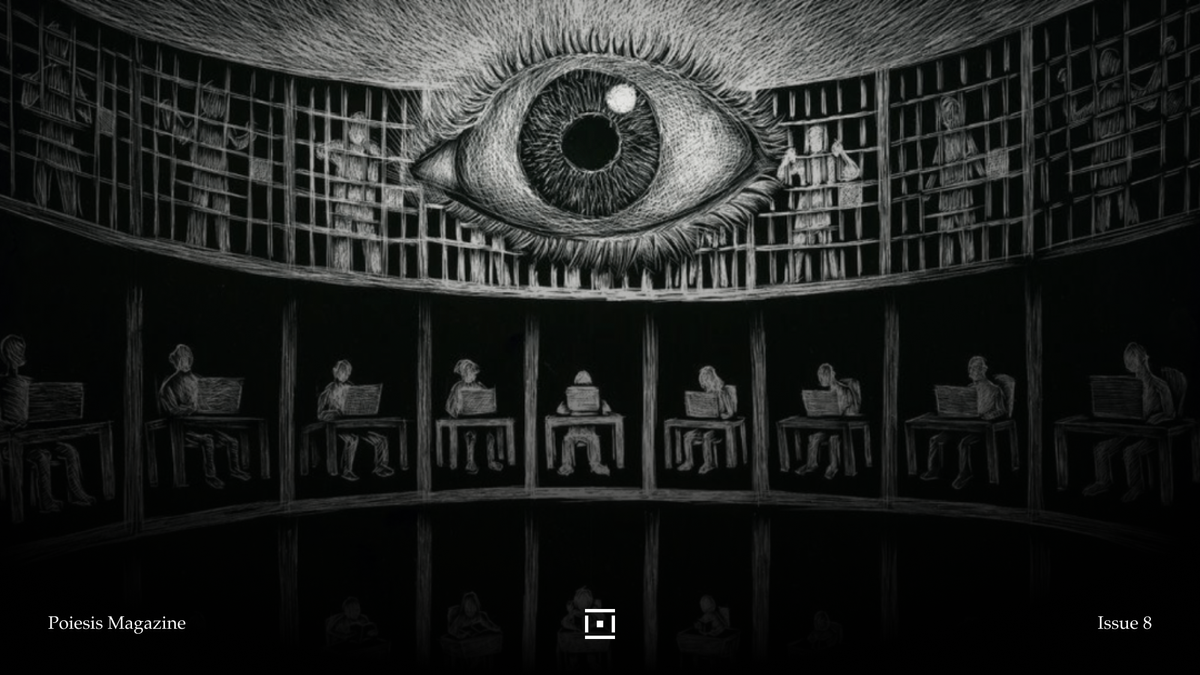
Bentham failed to implement the most powerful layer of control ever seen at the time. In the Panopticon, the guards could observe all prisoners at any moment, but the prisoners couldn’t tell when they were being watched. All cells were arranged in a circle, with a watchtower in the middle. He thought that it was revolutionary architecture that would change the prisoners’ behavior. His assumption was that, instead of brutal physical punishment, their character would change through observation. The parliament didn’t like the idea, and the prison was never built.
The concept was revisited by Michel Foucault, who argued that, conceptually, the Panopticon is a blueprint for how power works in modern society through surveillance and internalized discipline. Bentham couldn’t imagine how many shapes his idea could take. Today, we live inside a digital panopticon not by choice, but by being slowly forced to accept it as the norm. Each interaction with our devices is tracked, analyzed, and weaponized to extract more information from our attention.
Control through observation
The whole concept was built around the idea that uncertainty creates compliance. When you can’t tell whether you’re being watched, you assume you always are. This transforms external control into self-control. In this case, the medium has a powerful psychological impact on the people inside due to its design.
He tried to reduce violence, public executions, and torture by making the punishment invisible and constant rather than visible and occasional. This idea was an innovation more than two centuries ago, replacing dramatic displays of power with systematic observation that never stops. Even though he never implemented the project to test his hypothesis, Foucault recognized the Panopticon’s real power, not as a prison but as a surveillance mechanism for schools, hospitals, factories, and any other aspect of social life.
Designed for behavioral control
In the previous blog post, I wrote about the dystopian world presented in an episode of the Black Mirror series, where the environment's design and experience are similarly reminiscent of the Panopticon. Here is presented a reality where all walls are covered in screens. People watch entertainment all day, and the only thing they can do is cycle to earn a digital currency named “merits”. They were following a strict program and were asked to open their eyes when the screen detected they were not watching it.
This is the implementation of the panopticon concept that reveals a sad direction that our current society can take. All screens became observers, not passive devices that just display content. They took control instead of just being there on the wall. That’s a truth that starts to take shape in our modern reality. We’re exposed to all kinds of smart devices that collect information about our location, our sleep, our activity patterns, and so on. While this can be helpful, the problem arises when those start to dictate what, where, and how we do certain things, influencing how we live our lives.
Additionally, social media, gaming, and all platforms designed to leverage the brain’s reward system exploit the weakness of our dopaminergic system, turning our attention into a commodity sold over the digital counter or used in their own interests. These digital cells collect raw data, interpret it, and improve their captive mechanisms to control how people spend their time while using them. This mechanism goes beyond controlling user behavior. It controls how they perceive themselves, with some identifying with their digital twin, built in a parallel reality within those digital realms.
The beautiful interfaces we’re looking at all day are not always created solely by designers and developers but by psychologists, anthropologists, and data analysts.
Behaving as it should
With all the technology around us, the power of the concept goes beyond its initial purpose of controlling each individual’s behavior and now impacts the entire society. Algorithms and generative AI tools reveal the types of content people engage with, with fake news and highly emotional content being the most common. This kind of content triggers strong emotions in its viewers and neutralizes their critical thinking. By pushing the same type of content to billions of people, those platforms become the watchtowers of modern society.
Each participant in the attention economy holds the voting power that determines what’s important each day, hour, and minute. There is evidence showing that social media users change their appearances or posts, selecting only pictures to be seen in a better light than they are in real life. This fact just confirms Bertham’s intuition. People behave differently when they know their friends on social media are watching them. There’s an abundance of hand-picked, perfectly taken photos that are starved for that drop of the dopaminergic response of a like.
Bentham got it wrong
He believed that rational design and transparency would improve society. The panopticons represented a prison that would reform prisoners through self-awareness rather than external violence. It turned out that surveillance is easily used as a manipulative technique, rather than just for observation. The mechanism failed to empower people to make better choices but allowed powerful systems to control billions of people.
Ethics can’t be measured by mathematics, and the concept's failure demonstrates this. When designing digital products, it is not always advisable to improve all metrics. For example, improving user engagement on a social media platform can lead to addiction. Designing the experience of a food ordering app to increase the number of weekly orders can lead to unconscious spending or even health problems. Reducing the number of customers canceling annual subscriptions by hiding the menu or using dark patterns leads people to spend money without necessarily using your product. Usually, those numbers are tracked and analyzed solely to increase the company’s revenue and user retention.
Those unseen panopticonian patterns are used by many companies that prioritize numbers over their ethics, values, and principles. By leveraging the digital infrastructure of their beautifully designed cage, they harness all data to gain greater control over people’s will, minds, and behavior.
Conclusion
Even though it was never built in a physical shape, the Panopticon surrounds each of us every day. Its principles are applied in how digital products are designed and built. The only difference between its initial purpose and now is that we’re living inside a prison that was silently constructed around us.
The biggest bet of the last decade for companies building digital products was on people’s comfort. The most successful applications improve our comfort on a physical, psychological, or emotional level. This doesn’t mean we need to destroy our phones, uninstall all apps, and close all social media accounts, but it’s within our power to recognize when we’re in a digital cage and choose to resist it.
Digital products optimized for engagement will evolve toward control and manipulation unless deliberately constrained by their creators. The user’s liberty resides in the design itself, and those who create it have the power to alter it.
References
[1] Gingell, J., Little, A., & Winch, C. (2002). Modern Political Thought: A Reader. Routledge.
[2] van den Hoven J, Weckert J, eds. Information Technology and Moral Philosophy. Cambridge University Press; 2008.
[3] Just, N., & Latzer, M. (2016). Governance by algorithms: reality construction by algorithmic selection on the Internet. Media Culture & Society, 39(2), 238–258. https://doi.org/10.1177/0163443716643157
[4] Castro, C., & Pham, A. (2020). Is the Attention Economy Noxious? ResearchGate. https://www.researchgate.net/publication/343643632_Is_the_Attention_Economy_Noxious