
We buy things to reinforce our beliefs
This is my second entry in my digital journal. In the first part, I discussed how Apple replaced the screen time with battery usage in the phone settings and how these seemingly small changes shape our perception of ourselves.
Until a few years ago, I didn't have any wearables. No smartwatch, no smart bracelet, nothing. I'm a fan of analog devices. Still only wear classic, analog watches. The reason is simple. I don't need another screen on my wrist reminding me of unimportant things. Sure, I can disable notifications. But what about the battery? You have to recharge it every day. It's an additional stress.
Although I didn't want to add another screen to my life, I wanted to track my health. The most viable option has been a smart ring. A few grams fully packed with the latest technology. It became my personal health assistant. I'm blessed to have the honor of being assisted by my fellow soulless ring.
I had periods when I wore it all the time, periods when I forgot about it. In the last few weeks, I noticed something. I no longer want to wear it. I stopped caring about all the metrics, insights, and health-related information.
Why?
The other ring
I figured out the reason a few days ago. On a neighboring finger of it, I wear another ring. My wedding ring. Suddenly, the difference became clear. For my wedding ring, I created the initial moodboard and made the first sketches, embedding a spiritual meaning into the design of our wedding bands and my wife's engagement ring.
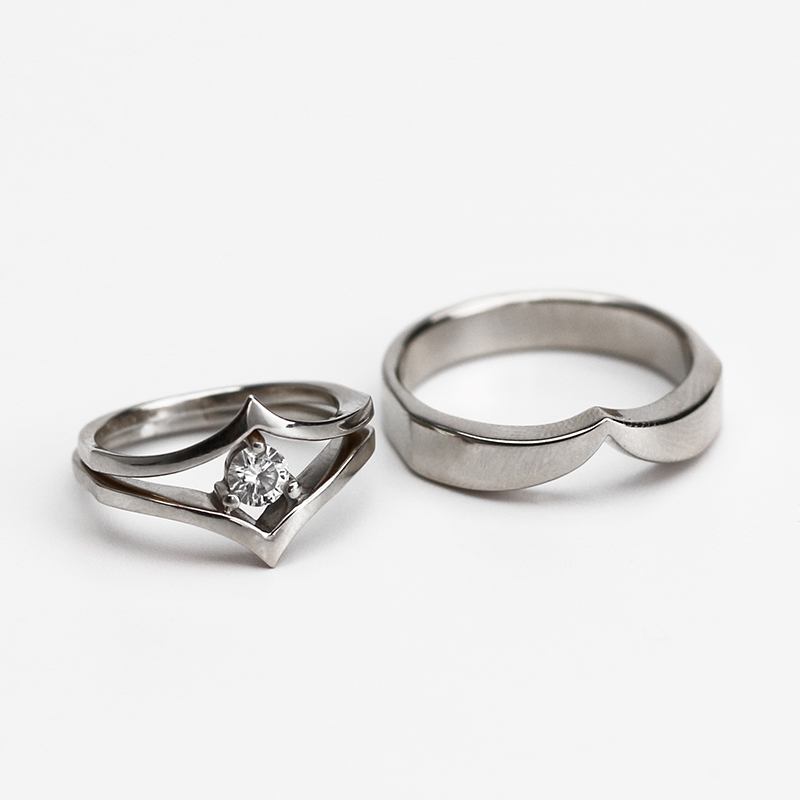
The depths and peaks link to our ups and downs. The diamond is held by three points: me, her, and God. Or the Holy Trinity. The rectangular shape on the sides represents the straightforwardness of our characters. Viewed from the side, it resembles a house, reminding us that our home is wherever we are together.
All of these were masterfully designed and produced by Contemporia, one of the best jewelers in Romania. I visited their creative studio multiple times. Discussed how things should look. Brainstormed the whole story. Took part in the entire process. It was an immersive experience lasting over four months. A truly unique experience that embeds the story of our souls in carefully crafted jewels that would be with us for life.
On the other hand, when it came to the other ring, I logged into a website, added it to my cart, paid, and started wearing it the next day. The only thing I traded was money. I received the same ring as millions of others. No personal story. No involvement. Nothing.
Products vs. Artifacts
The smart ring is a product I consumed. The wedding ring is an artifact I co-created.
A smart ring is a piece of hardware with sensors, a battery, and circuits. Even if it's amazing hardware, it has no soul. It's not part of me. I didn't take part in designing it. I'm just another consumer. The difference isn't in quality, utility, or beauty. The difference is the soul poured into the thing. The quantity of soul was invested while the product was acquired.
It doesn't matter that my wedding ring lacks sensors, an app, or AI telling me I need to sleep at least 7 hours to feel better. I don't care. The process of creating it is unmatched. I didn't want to rush the process of making our wedding bands. I didn't want to have them NOW. I wanted something that lasts a lifetime. An artifact that reflects our values and reminds us of what's important each time.
We buy identity, not utility
I said I consider myself a healthy person and want to live a long, healthy life. This value should influence my purchase behavior accordingly, right? The ring lets me track my health. Why wouldn't I buy it? Truth is, I can live without it. Billions lived without tracking health until wearables appeared. So why did we keep buying them?
Glen Parson wrote in Philosophy of Design that "we buy things not for utility, but based on our self-image". We link our identity to the things we own. We purchase items to reflect our core beliefs or internal sense of self outwardly. I bought the smart ring not because I needed to monitor my health metrics, but because I have the core belief that I am a healthy person and wanted to make that visible in some way.
That's more likely an identity purchase, not a utility purchase.
Identity purchases are shortcuts. Actual health comes from years of good habits: eating well, exercising regularly, getting enough sleep, and managing stress effectively. None of these requires a smart ring. The ring makes you look serious about your health.
Who wants to do all that stuff? It's quite challenging to go outside, take a walk, prepare healthy meals, and stop scrolling on social media at a decent hour to get a good night's sleep. It sounds boring. It sounds much better to have a piece of steel in your hand that screams, "I'm into health." Everybody would know that you're serious about your health.
The hidden cost of convenience
This pattern is everywhere around us. We live in an era of convenience, comfort, and consumerism. One-click purchase. Next-day delivery. No friction. No process. Instant gratification on steroids.
I see this in AI tools that skip years of learning and rob us of creative development. In fast fashion, that destroys uniqueness and craftsmanship. In fast food, which destroys the health of tens of millions of people.
Always the same promise: "Get the result without the process."
But the process is the point. When we skip the process, we end up with the object without pouring our heart into it. That's why the smart ring sits in my drawer, and the wedding ring never leaves my finger.
Best,
George
View my workwhich